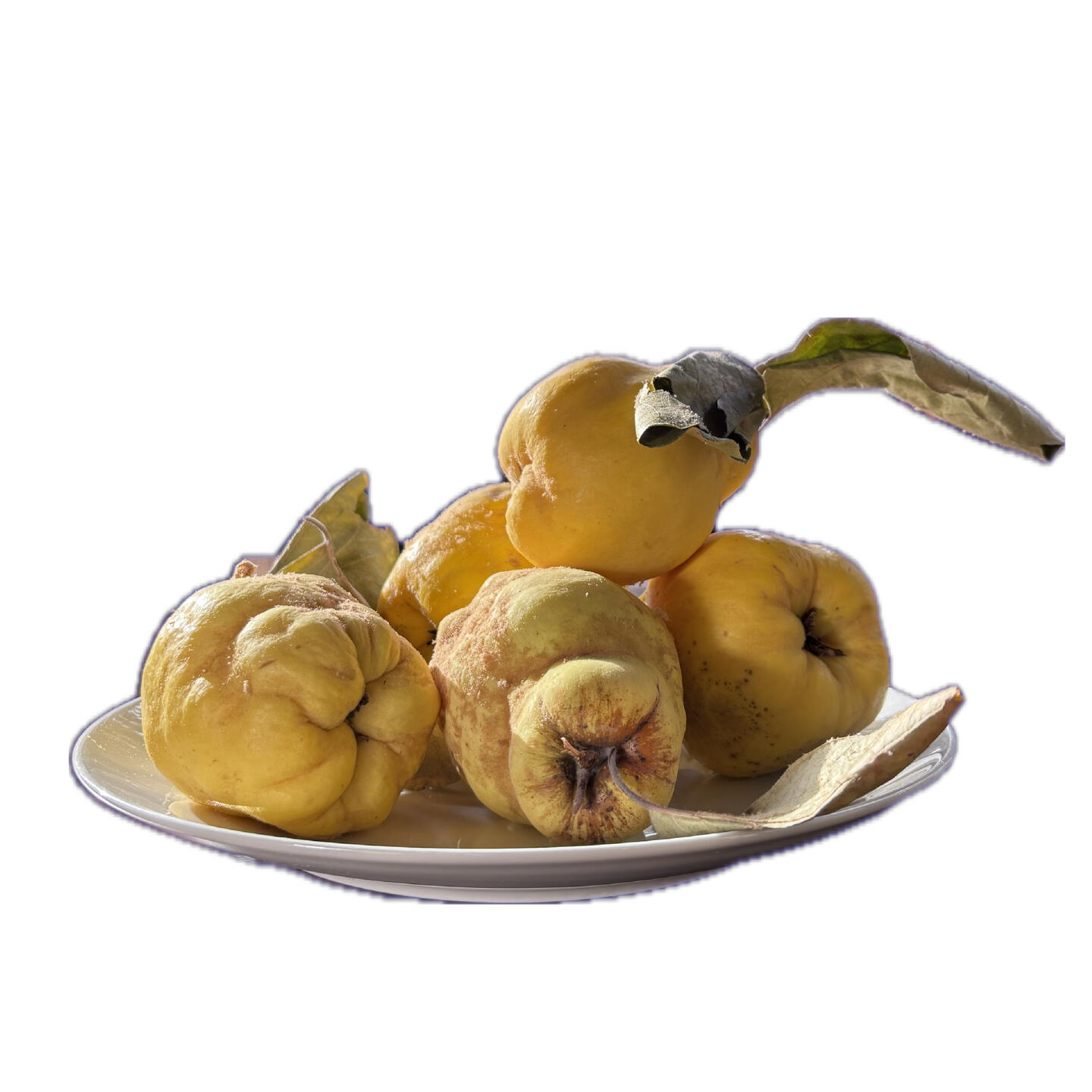
Quince
An interlude
Thanksgiving is coming. I’m taking a break from my volunteer project, a four-week campaign exploring some of the history of the materials we sort into our community’s recycling bins.I’ve lost track of how long a week is. We began with paper, to a modest audience, then introduced glass during the election, and attention waned. I’m still working on plastic. It gives me a headache. Every rule has an exception. It’s like learning a new language I never want to speak.So I’m taking a pause to prepare quince instead, a bugger of a fruit that appears for a sliver of time in autumn, when friends with trees are happy to unload them.I would eat quince all year long if only I could.There is something rather wonderful about a fruit that refuses to be hurried and has been stirring up trouble for thousands of years.In ancient Greece, the quince may have been the golden apple of discord, awarded to Aphrodite by Paris, setting in motion the events leading to the Trojan War. In other lore, it is the original forbidden fruit, the apple of Adam and Eve.Whether you regard quinces with reverence or dismiss them as ugly and unmanageable depends on how well you know them.Round at the hips with narrow shoulders, their fuzzy complexions are golden yellow, leaning toward a lemony green, not quite chartreuse. They sit like the dowagers of Rittenhouse Square, flaunting fascinators of dusty sage-green leaves as if just returned from a royal wedding.You don't want to eat them raw. Hard, acidic and astringent, their flesh will pucker your mouth dry.The seeds are poisonous, like those of apples and pears. They contain compounds that can release cyanide. Not something you want in your preparations.Quinces brown quickly too, once cut, assuming you've managed to avoid bloodying your fingers in the process.There is a trick, though. Ten to twenty minutes in a 350-degree oven softens the flesh enough to make them easier to handle once cooled.For all their difficulties, quinces are beguiling once you learn how to treat them.These quinces are destined for a King's Kake.Their flesh will be candied, simmered long in sugar and spice—star anise, clove, cardamom, vanilla and lemon—until it turns a translucent, deep magenta amber.Their scent, the faintest of rose, when mingling with warm spices is like slipping through the curtains of a caravan, into a world impossibly vast.
pasta water
stock
cream / milk
parsley water
Gremolata
Finely chopped raw herbs, usually parsley, garlic, and zest. Added in the final moments of a dish or served alongside, it provides a welcome counterpoint to a rich, savory dish.
Farro
Among the first grains domesticated in the ancient near east and has remained traditional in parts of Central and Southern Italy since Roman times. In appearance, it looks like brown rice and has a delicate, nutty flavor. Use whole-grain farro. It cooks quickly and becomes chewy tender.~The Zuni Cafe CookbookMethod
To one cup whole-grain farro cover with water, about three cups and salt. Simmer, uncovered until tender, 10 - 15 minutes. Drain and spread on a sheet tray to cool and dry.